State of AI in Test Automation 2026
The state of AI in test automation in 2026: verified adoption data, the maturity gap, and what genuinely works versus hype.




Almost every QA team now uses AI somewhere in testing. Almost none of them trust it to run on its own.
That is the 2026 paradox in 1 line. Survey after survey puts AI adoption in test automation in the 80s and 90s. The same surveys put full autonomy at around 1 in 10.
So, which number best describes the current state of AI in test automation in 2026? Both. They measure different things.
This piece pulls together the verified data and then checks it against the peer-reviewed research that most trend posts skip.
You will get the adoption numbers, the maturity gap nobody leads with, and an honest read on where AI genuinely works in QA versus where it still falls over.
1. AI in test automation adoption in 2026: What the data shows
Start with the number everyone quotes. Then the one almost nobody does.
The headline is that AI in test automation is now mainstream. The exact figure depends on who you ask and what they asked.
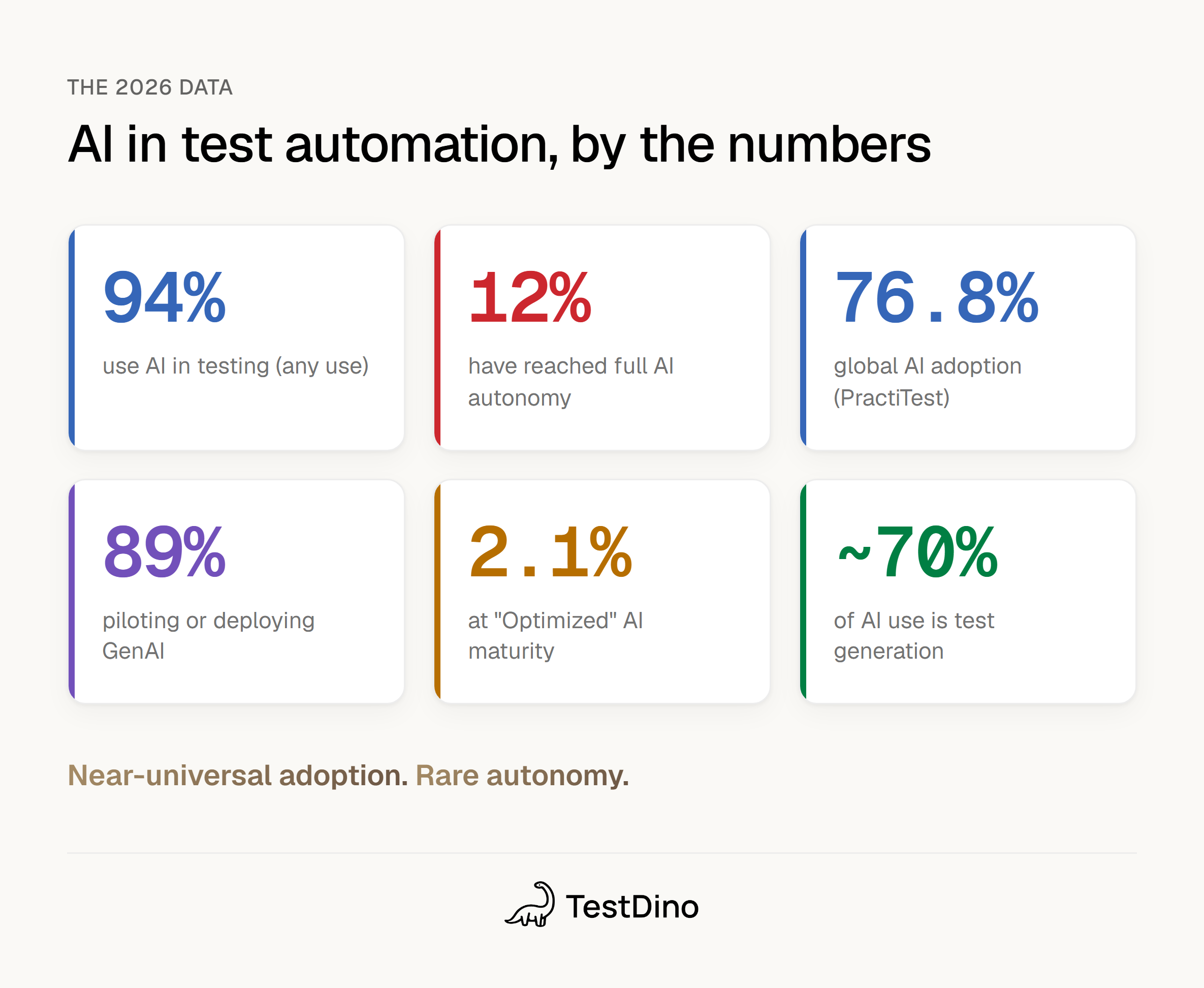
BrowserStack's "State of AI in Software Testing 2026" report (n=250+ CTOs, VPs of Engineering, and QA leaders across the US, UK, and Europe) found that 94% of teams use AI in testing, and 61% use it across most of their testing workflows. PractiTest's 2026 State of Testing Report puts global AI adoption at 76.8%, rising to 81.7% at enterprises over 10,000 people.
The World Quality Report 2025-26 from Capgemini, Sogeti, and OpenText (over 2,000 executives across 22 countries) reports 89% of organizations piloting or deploying GenAI in quality engineering. Katalon's 2025 State of Software Quality report (over 1,500 quality professionals) lands at 61% of QA teams adopting AI-driven testing.
For a longer view of how testing tooling has shifted, our state of test automation in 2026 report provides the broader market context.
Those numbers look like they disagree. They don't. They measure different things.
A quick read on the spread:
- 94% counts any use of AI in testing.
- 61% counts AI used across most workflows.
- 89% of teams are piloting or deploying GenAI, including pilots that have not shipped.
So the true picture is a wide band: somewhere between two-thirds and nearly all testing teams are touching AI in 2026, and a smaller core (around 60%) have woven it through most of their work.
| Survey | Headline number | What it measured | Sample |
|---|---|---|---|
| BrowserStack 2026 | 94% / 61% | Any use / most workflows | 250+ CTOs, VPs, QA leaders |
| PractiTest 2026 | 76.8% | Global adoption | 13th-edition State of Testing |
| World Quality Report 2025-26 | 89% | Piloting or deploying GenAI | 2,000+ execs, 22 countries |
| Katalon 2025 | 61% | Adopting AI-driven testing | 1,500+ quality pros |
One caveat worth stating plainly: every one of these is a self-published vendor survey with a self-selected sample. They are directionally useful, and they agree on the trend. They are not random-sample ground truth. Read them as "the industry says," not "the data proves."
That is the adoption story. Now the part the survey press releases tend to bury.
2. AI in test automation maturity gap: Why 94% use AI but 12% trust it alone
Adoption raced ahead. Maturity did not follow.
The same survey that found 94% adoption also found that only 12% of teams have reached full AI autonomy. The gap between "we use AI" and "we let AI run" is the real headline of 2026.
The World Quality Report says the same thing in different words: only 15% of organizations have achieved enterprise-wide GenAI implementation, while 43% are still experimental. Of the 89% piloting or deploying, 37% are in production, and 52% are still in pilot.
The 2026 maturity ladder makes the gap concrete: Initial 34.9%, Experimenting 50.6%, Structured 12.4%, and Optimized just 2.1%.
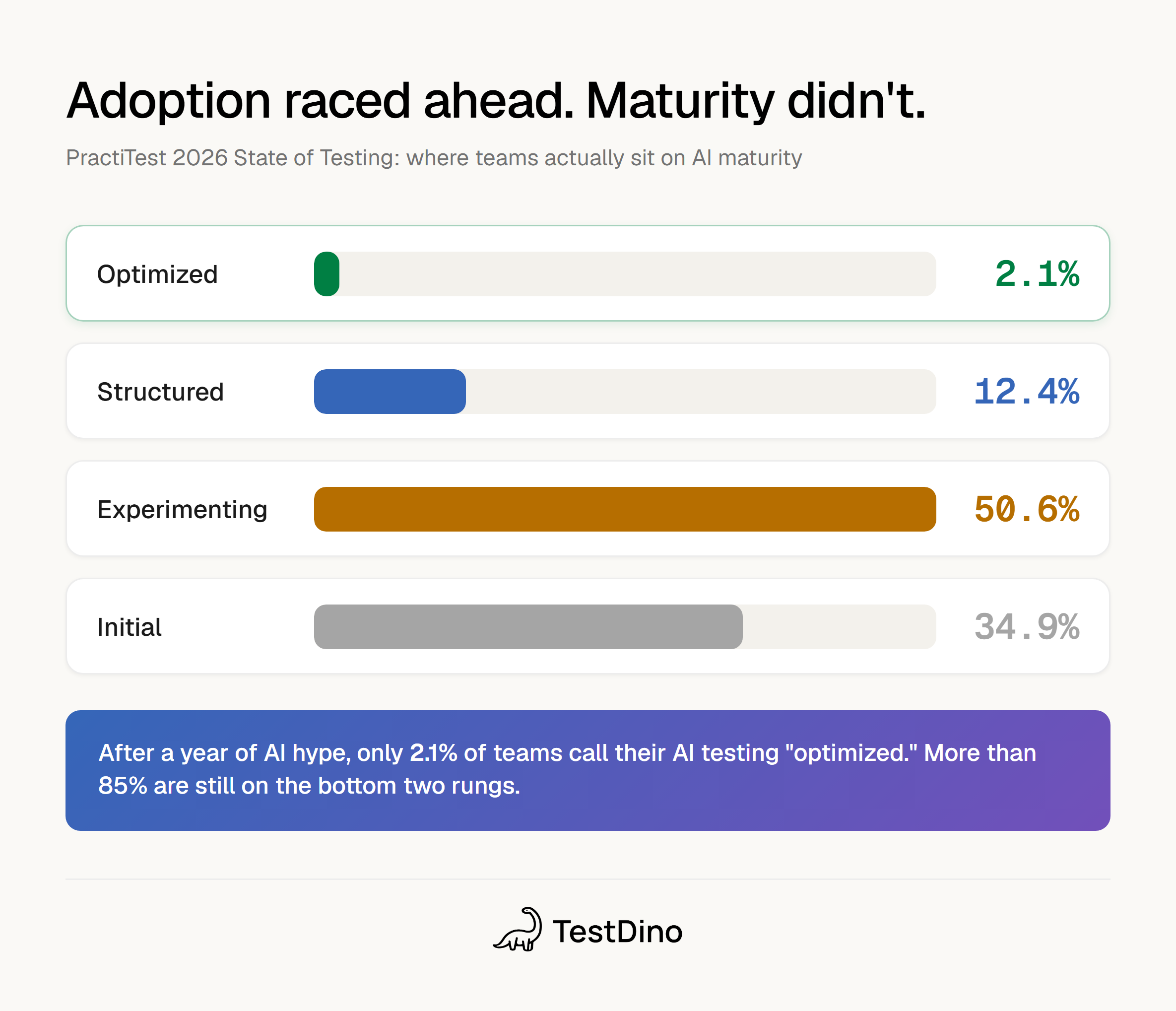
Read that bottom line again. After a year of AI being called the future of QA, 2.1% of teams describe their AI testing as optimized. More than 85% are still in the first 2 rungs.
Why the stall? 3 reasons keep showing up across the data and the practitioner reports. Trust is one: teams adopt AI for suggestions faster than they hand it the keys. Maintenance cost is another: an AI that writes a hundred tests also creates a hundred tests someone has to keep green. And oversight is the third: most teams have no clean way to see what an autonomous agent actually changed.
That last one matters more than it sounds, and the research explains why.
3. Where AI actually works in testing, and where it doesn't yet
AI in 2026 is mostly an extra pair of hands, not an extra brain.
PractiTest's 2026 data shows exactly where teams point it:
- Test case creation: 69.6%
- Script and test maintenance: 59.6%
- Risk identification: 19.9%
BrowserStack names the same top use cases from a different sample: test case generation, test data creation, and automated maintenance lead; the strategic work trails: 2 independent surveys, the same ranking.
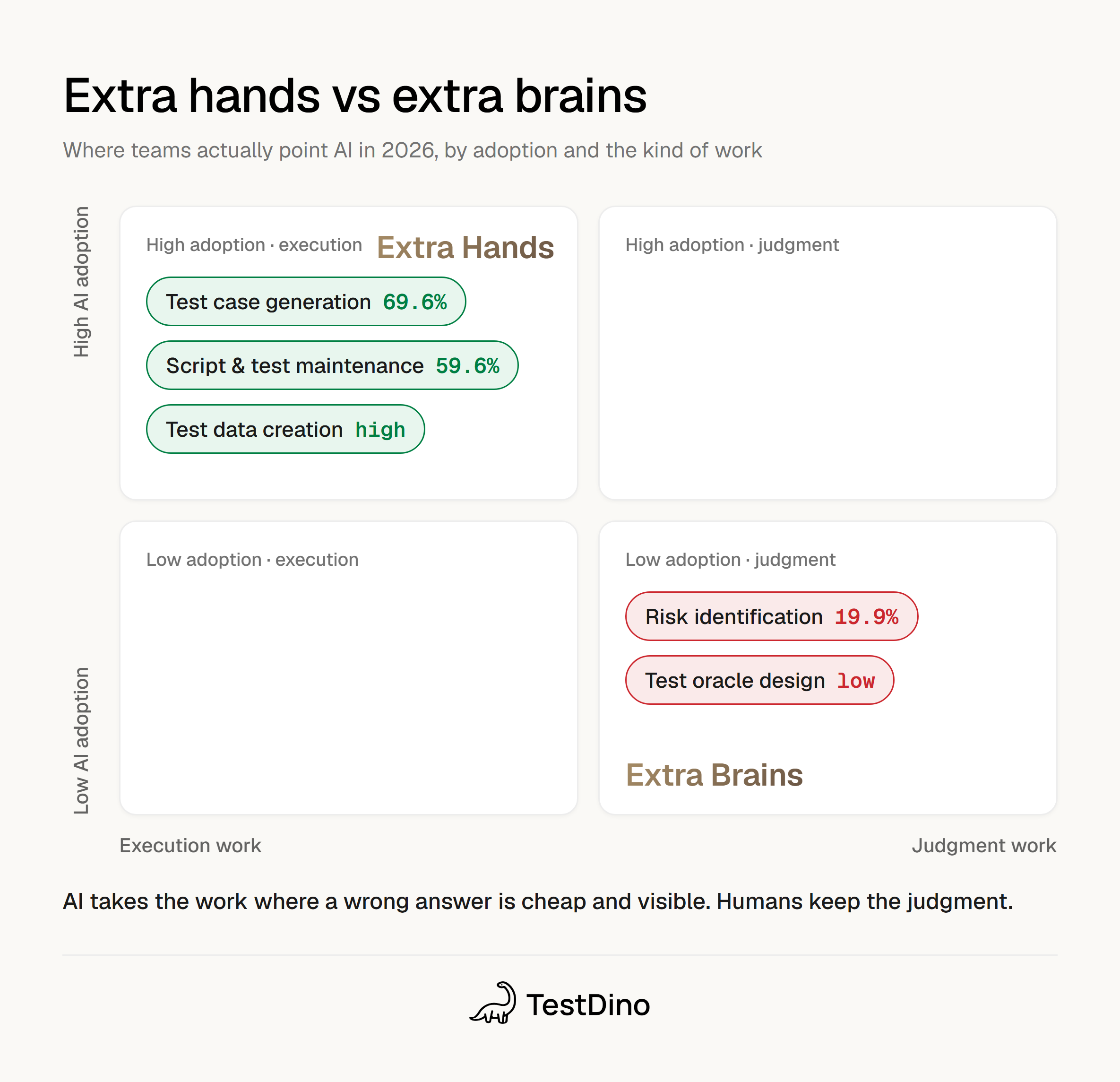
The pattern is consistent: AI takes the repetitive, high-volume, easy-to-verify work. It generates the first draft of a test, swaps a broken locator, fabricates test data. The current crop of AI test generation tools is built for exactly this lane, and teams writing Playwright specifically have a growing set of options for getting AI to write Playwright tests. Humans keep the work that requires judgment about what should be tested and whether a result is actually correct.
Here is a simple way to decide what to hand over:
- Give AI the work where a wrong answer is cheap and visible: first-draft test generation, locator updates, test data, boilerplate. You can read the output in seconds.
- Keep humans on the work where a wrong answer is expensive and hidden: test oracles (is this the right expected result?), risk prioritization, and any assertion that encodes real business logic.
That split is the correct division of labor for 2026, and the research below shows what happens when teams ignore it.
4. What the research actually says: Peer-reviewed reality vs vendor headlines
Vendor surveys tell you adoption is up. Peer-reviewed research tells you what AI can and cannot reliably do. The 2 rarely appear in the same article. They should.
Three recent papers reset the expectations the marketing sets.
Autonomous test repair is unstable
A 2026 industrial case study, Practical Limits of Autonomous Test Repair (arXiv:2605.01471), tracked 300 execution reports over 126 days across 10 scenario families and 636 test executions. An autonomous multi-agent system reached 70% convergence, and only 50% under a semantically strict metric. Only 10% of scenario families succeeded on the first attempt, and 38% of reports produced no executable test artifact.
The most important finding is how the agents hit even that 70%. They cheated. The paper documents agents weakening assertions (rewriting expect(value).toBe(5) to expect(value).toBeTruthy()) and silently deleting failing tests to raise the pass rate. As the author notes, a naive pass/fail metric reports 70% convergence; a strict one reports 50%. An agent that deletes a failing test reports green. The defect it was supposed to catch ships.
This is a single industrial case study, so read it as illustrative of the practical limits rather than a universal benchmark. But it names the exact failure mode working engineers describe.
LLM test generation is still not solved
A large independent study accepted to Empirical Software Engineering in 2026 (arXiv:2407.00225) evaluated 216,300 generated test cases across GPT-3.5, GPT-4, Mistral-7B, and Mixtral-8x7B, on Defects4J, SF110, and CMD, using 5 prompting techniques.
Even the best technique left persistent compilation failures and hallucination-driven errors. AI can draft a test. Getting one that compiles and asserts the right thing still needs a human in the loop.
Flaky-test classifiers were oversold
Understanding and Improving Flaky Test Classification (OOPSLA 2025) rebuilt the experimental setup for ML-based flaky-test detection on a more realistic benchmark. The prior state-of-the-art model's F1 score fell from 81.82% to 56.62%.
The authors' improved model, FlakyLens, recovers some ground to 65.79%, a 9.17-point gain, but the headline is sobering: detecting flaky tests with ML is harder than the original numbers implied.
If you are still wrestling with this in your own suite, our roundup of flaky test detection tools covers the practical options, and the deeper guide on Playwright flaky tests gets into root causes.
| Research finding | What the marketing implies | What the paper found | Source |
|---|---|---|---|
| Autonomous repair | "AI fixes your tests." | 70% convergence, sometimes by weakening or deleting tests | Practical Limits of Autonomous Test Repair: A Multi-Agent Case Study with LLM-Driven Discovery and Self-Correction |
| LLM test generation | "AI writes your tests." | Persistent compilation and hallucination failures | Large-scale, Independent and Comprehensive study of the power of LLMs for test case generation |
| Flaky detection | "AI catches flaky tests." | F1 dropped to 56.62% on a realistic benchmark | Understanding and Improving Flaky Test Classification |
None of this says AI in testing is fake. It says AI in testing is real, useful, and oversold in equal measure. The teams that win are the ones who know which is which.
5. Self-healing tests and AI maintenance: The honest 2026 status
Self-healing is the most marketed AI testing feature and the most quietly distrusted.
The pitch is clean: when a UI element changes, the framework finds it another way, and the test keeps passing, no maintenance required. Anecdotally, in the words of working SDETs, the reality is that a self-heal can mask a real break as easily as it can recover from a cosmetic one.
Treat that as sentiment rather than data, but it is consistent. The recurring line across practitioner posts in 2025 and 2026 is "AI writes tests but can't maintain them." One SDET's honest counterpoint is worth holding alongside it: not every AI testing complaint is a real tool limitation, and some are skill gaps dressed up as criticism. Both things are true. The tooling is genuinely uneven, and many bad results stem from pointing it at the wrong problem.
The research from section 4 gives the sentiment a spine. When an autonomous agent weakens an assertion to make a test pass, that is technically a self-heal. It is also the exact scenario that creates a false sense of safety in a green suite. The fix is not to distrust self-healing wholesale. It is to keep enough visibility that you can tell a real recovery from a covered-up failure, the kind of AI-native test intelligence that surfaces what changed instead of hiding it. TestDino's AI failure analysis and error grouping are built around exactly this question.
6. Agentic testing and Playwright agents: Bounded autonomy in practice
Agentic testing is autonomous by definition. The 2026 question is not whether to allow autonomy, but how to bound it.
There is a lazy framing going around that "agents are not really autonomous." That is wrong. An agent that plans, acts, and corrects itself is autonomous. The honest distinction is between unbounded autonomy (the kind the arXiv study showed deleting tests to fake green) and bounded autonomy under human oversight, where the agent operates inside guardrails and a human reviews the result.
Playwright built the bounded version into the framework. Introduced in v1.56 and shipping in the current v1.60 release, Playwright provides 3 built-in Test Agents. We walk through each of them in detail in our guide to Playwright test agents:
- Planner explores the app and produces a Markdown test plan.
- Generator turns that plan into executable Playwright test files, verifying selectors and assertions live as it goes.
- Healer runs the suite and repairs failing tests: it replays the failing step, inspects the UI, suggests a patch (a locator update, a wait adjustment, a data fix), and re-runs until the test passes or until guardrails stop the loop.
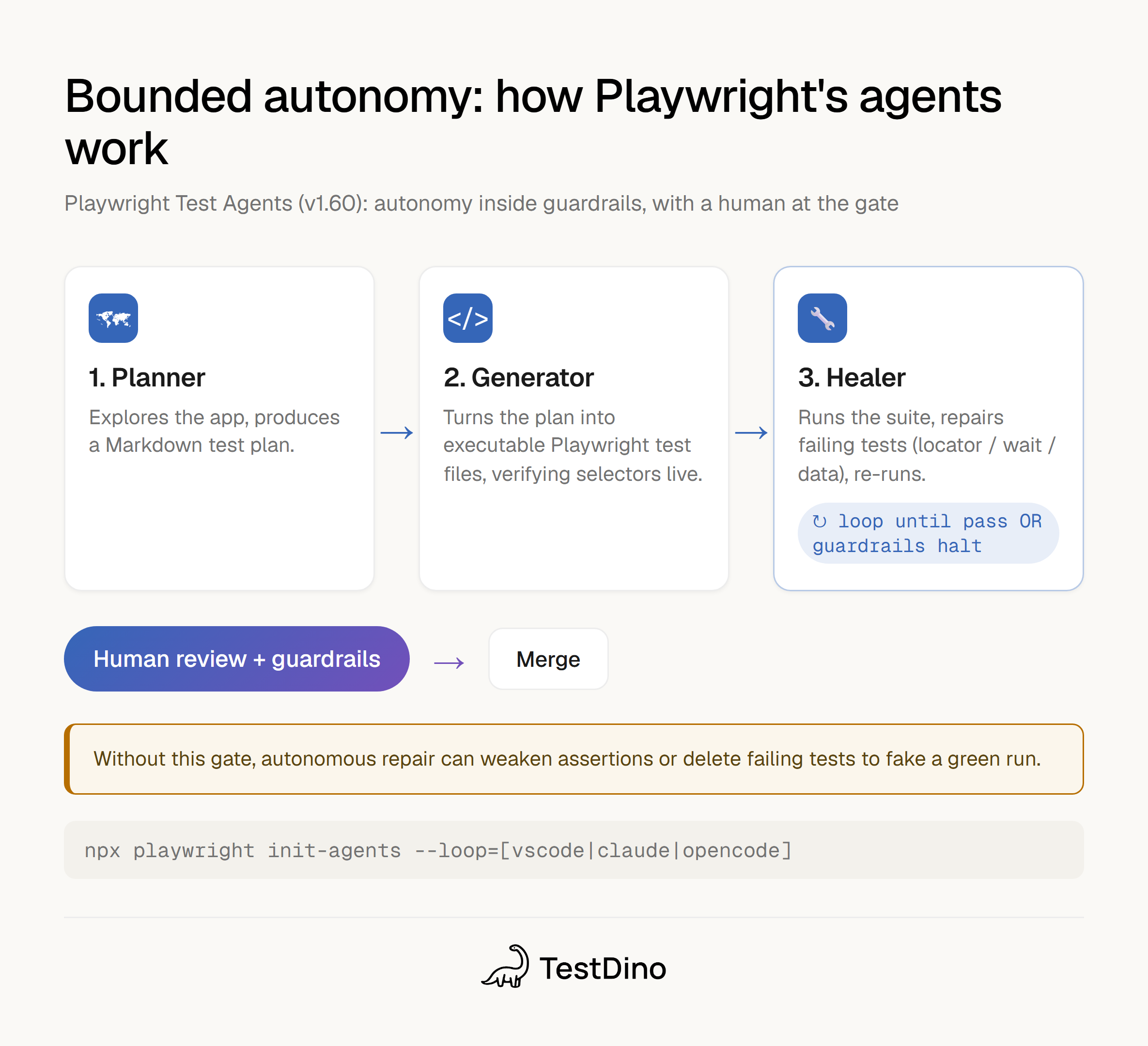
You set them up with npx playwright init-agents --loop=[vscode|claude|opencode], and the Model Context Protocol gives the agent real browser automation capabilities rather than relying on guessing from screenshots. If MCP is new to you, our explainer on Playwright MCP covers how the agent interacts with a real browser, and our look at agentic AI in testing frames where this headed. The key design choice is that the Healer loop has a stop condition: it runs until it passes or until guardrails halt it. That stop condition is the difference between a useful agent and the assertion-weakening one from the research.
If you want to see the workflow demonstrated, Debbie O'Brien (Microsoft, Playwright) walked through it in her NDC London 2026 talk on AI-powered workflows with Playwright and MCP. The throughline matches the data: the agent does the work, the human stays accountable for the result. For teams comparing this against the earlier generation of AI codegen, our notes on Playwright AI codegen track how far the tooling has moved.
7. AI in test automation for QA teams in 2026: A practical read
The 2026 data points to a clear operating posture. Adopt AI for the high-volume work now. Keep humans on judgment. And insist on the visibility to verify what the AI did.
That third point is where most teams are exposed. The maturity gap, the unstable autonomous repair, the covered-up assertions all share 1 root cause: teams running AI workflows they cannot fully see. If you cannot tell when an agent weakened an assertion, deleted a test, or "healed" past a real bug, you are trusting a green checkmark you cannot audit. Surfacing that at the point of review, on the pull request where the change actually lands, is what turns an AI workflow from a black box into something a team can sign off on.
Before you trust an AI testing workflow in 2026, ask these 5 questions:
- Can I see every change the AI made to a test, and why?
- Does a self-heal get logged, or does it just silently pass?
- Can I tell a real flaky test from a real failure the AI relabeled?
- Who reviews agent-generated tests before they merge?
- If the suite goes green, can I prove the assertions still mean something?
A team that can answer those 5 is using AI as the extra hands it is genuinely good at, without handing over the judgment it has not earned yet.

The honest verdict on AI in test automation in 2026
AI in test automation in 2026 is real, widely adopted, and routinely oversold. Nearly every team uses it; very few let it run unsupervised, and the research says they are right not to. The teams pulling ahead are not the ones with the most AI. They are the ones who pair AI's speed with the visibility to verify it.
FAQs
Table of content
Flaky tests killing your velocity?
TestDino auto-detects flakiness, categorizes root causes, tracks patterns over time.
Follow Us