Playwright Market Share: Usage Data, Downloads & Trends
Playwright’s market share surged in 2026, with adoption nearing half of modern automation teams. Its speed, reliability, and cross-browser support have made it a leading choice for fast, CI/CD-driven testing.




Playwright has cemented its position as the fastest-growing test automation framework in 2026, as the Playwright market share is rising across enterprise teams.
With 88,500+ GitHub stars, 720+ contributors, and roughly 52 million weekly npm downloads, it now outpaces every competing browser automation tool on raw download volume.
An estimated 12,000+ companies worldwide run Playwright in production, including Fortune 500 names like Amazon, Microsoft, Apple, NVIDIA, and Walmart.
The automation testing market reached USD 41.67 billion in 2025 and is projected to hit USD 169.33 billion by 2034, growing at a 16.90% CAGR.
Playwright sits at the center of this expansion. Its multi-language support (TypeScript, Python, Java, .NET), Microsoft backing, and agentic testing capabilities introduced in v1.59 position it as the default choice for teams modernizing their test infrastructure.
Official GitHub metrics and community data
1. Repository statistics
The official Playwright GitHub repository provides verified community engagement metrics as of May 2026:
| Metric | Value |
|---|---|
| GitHub stars | 88,500+ |
| Forks | 5,700+ |
| Contributors | 720+ active contributors |
| Repositories using Playwright | 500,000+ |
| Total GitHub releases | 160+ |
| Latest stable version | v1.59.1 (April 2026) |
| Primary language | TypeScript (91.0%) |
These numbers represent a significant jump from November 2025, when the repo showed 78,600 stars and 662 contributors. That is a 12.6% increase in stars and 8.8% growth in active contributors over just six months, reflecting accelerating community momentum.
2. npm download growth
Playwright's npm ecosystem tells an even more dramatic story. The core playwright package pulls 52 million weekly downloads as of May 2026. For context, Playwright's weekly downloads in January 2022 hovered around 1.2 million. That is a 4,233% increase over four years.
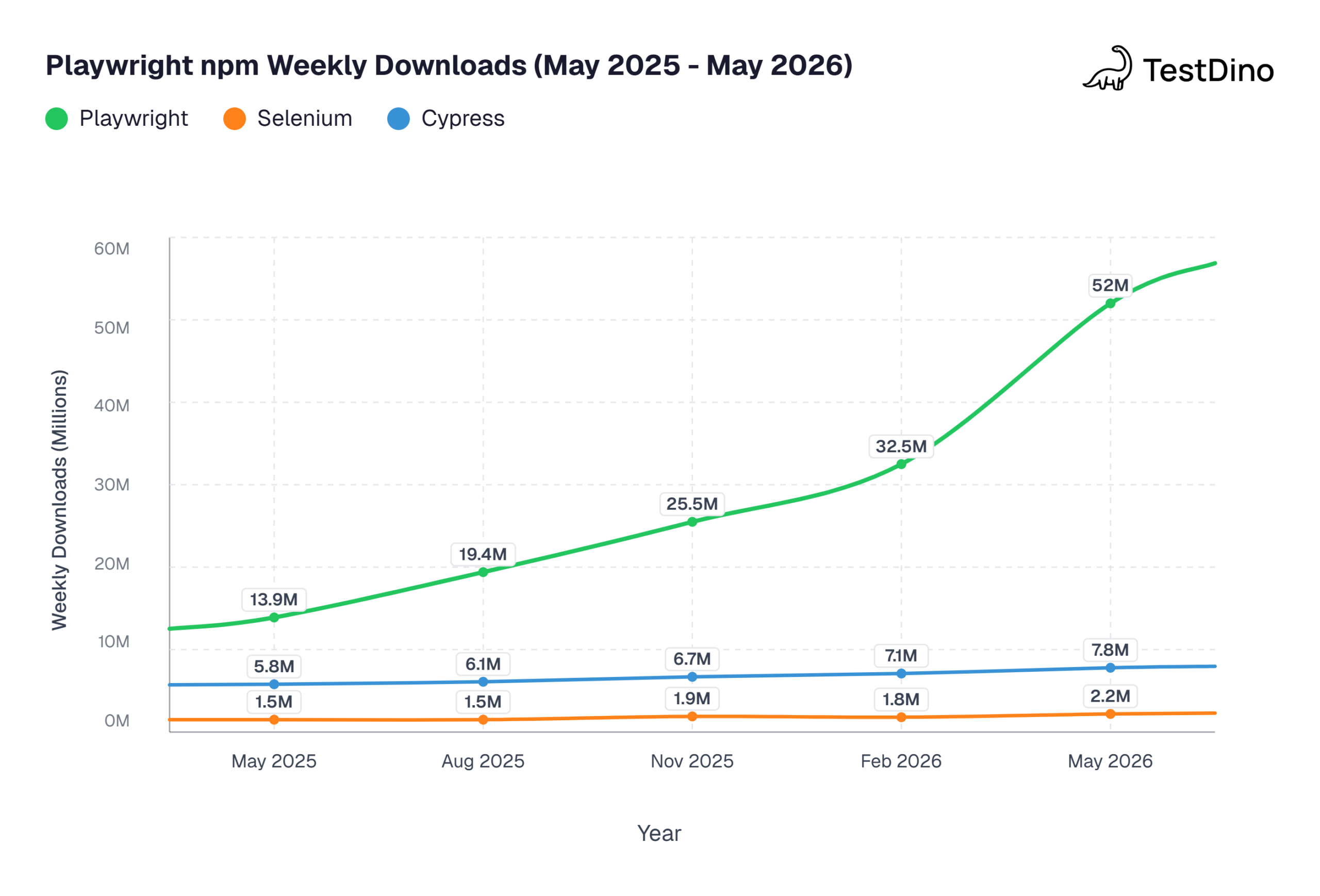
The @playwright/test runner package, which most teams use directly, adds millions more on top of the core package. Combined, the Playwright ecosystem accounts for the largest share of browser automation downloads on npm.
3. Comparative GitHub analysis
| Metric | Playwright | Cypress | Selenium |
|---|---|---|---|
| GitHub stars | 88,500+ | 49,600 | 34,100 |
| Forks | 5,700+ | 3,400 | 10,500+ |
| Weekly npm downloads (M) | 52 | 7.8 | 2.2 |
| Active contributors | 720+ | 450+ | 350+ |
| Latest release | v1.59.1 | v14.x | v4.x |
Key insights from this comparison:
- Playwright leads in GitHub stars by 78% over Cypress and 159% over Selenium
- Playwright's npm downloads are roughly 7x Cypress and 24x selenium-webdriver
- Selenium maintains the highest fork count due to its 20-year history and multi-language bindings, but its npm download trajectory has flattened
- Playwright's contributor count grew from 662 to 720+ between November 2025 and May 2026, a pace that Cypress and Selenium have not matched
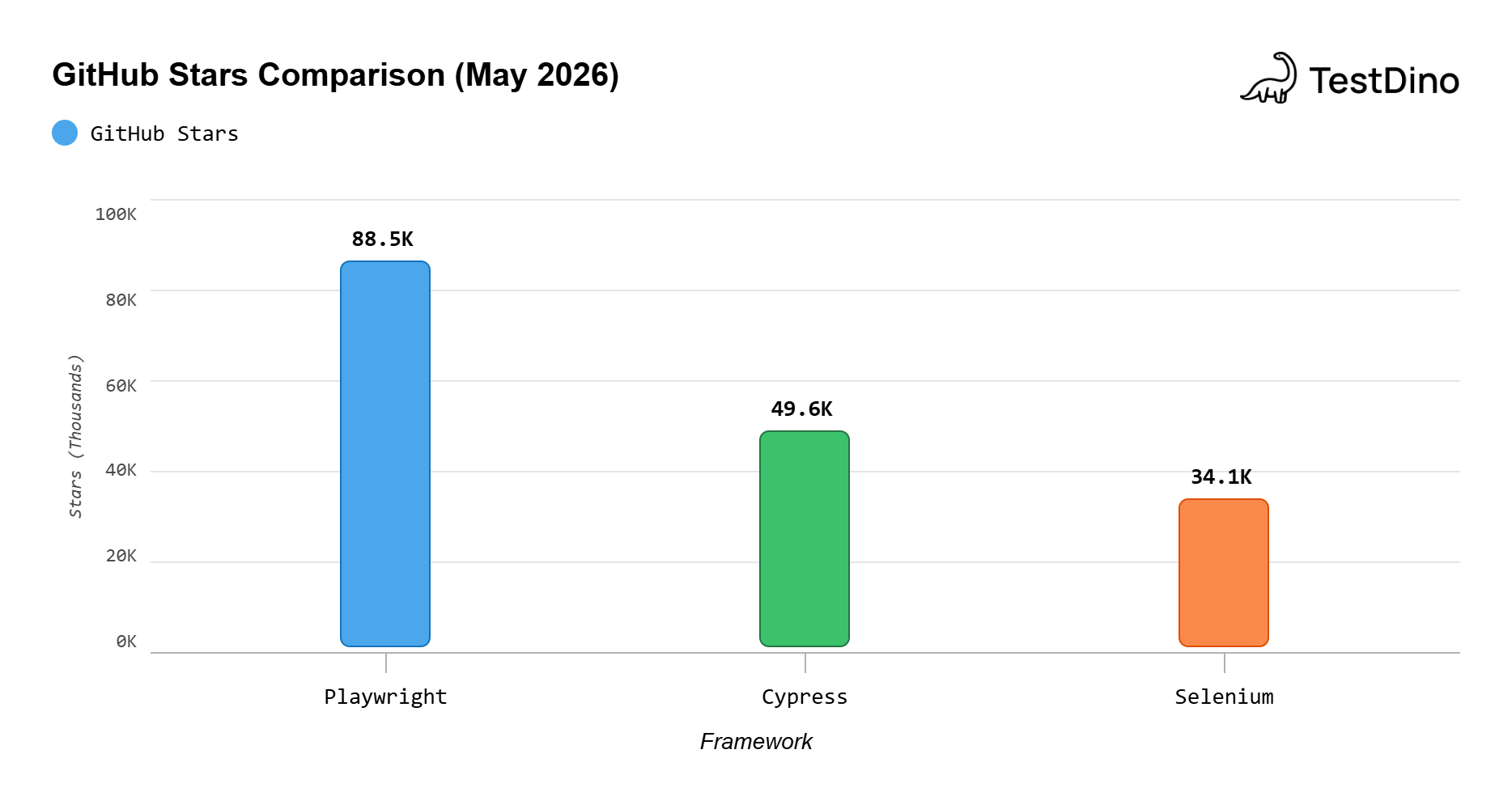
Teams evaluating a Playwright vs Selenium comparison or considering Playwright vs Cypress will find that raw community momentum now clearly favors Playwright across every major metric.
Playwright test automation usage and adoption data
1. Enterprise usage statistics
As of May 2026, over 12,000 verified companies use Playwright across industries, sizes, and regions:
- Verified companies using Playwright: 12,000+
- Fortune 500 users: Amazon, Walmart, Apple, NVIDIA, Microsoft, CVS Health, McKesson, IBM, Procter & Gamble, UnitedHealth Group
- Notable adopters: Spotify, Adobe, ING Bank, Cox Automotive, Tryg Forsikring, Shift4, Genesys, Tyler Technologies, WordPress, Elastic
2. Industry distribution
Top industries adopting Playwright based on verified company data:
- Software: SaaS platforms, product-based technology companies
- Business services: Consulting firms, professional services agencies
- Finance: Fintech startups, traditional banking institutions
- IT services: Custom development shops, system integrators
- Manufacturing: Enterprise systems, industrial automation
- Healthcare: Health tech platforms, insurance systems
These patterns align with the broader shift toward modern web application testing and the growing adoption of AI-augmented test automation tool stacks.
3. Geographic distribution
Based on GitHub contribution patterns, job posting concentrations, and verified geographic data:
- United States: Leading adoption region, driven by Silicon Valley and enterprise modernization
- India: Fastest-growing market, fueled by IT services companies and startup ecosystems
- Germany: Strong European presence with automotive and industrial tech adoption
- United Kingdom: Established user base across fintech and e-commerce
- Canada: Growing enterprise adoption in financial services and telecom
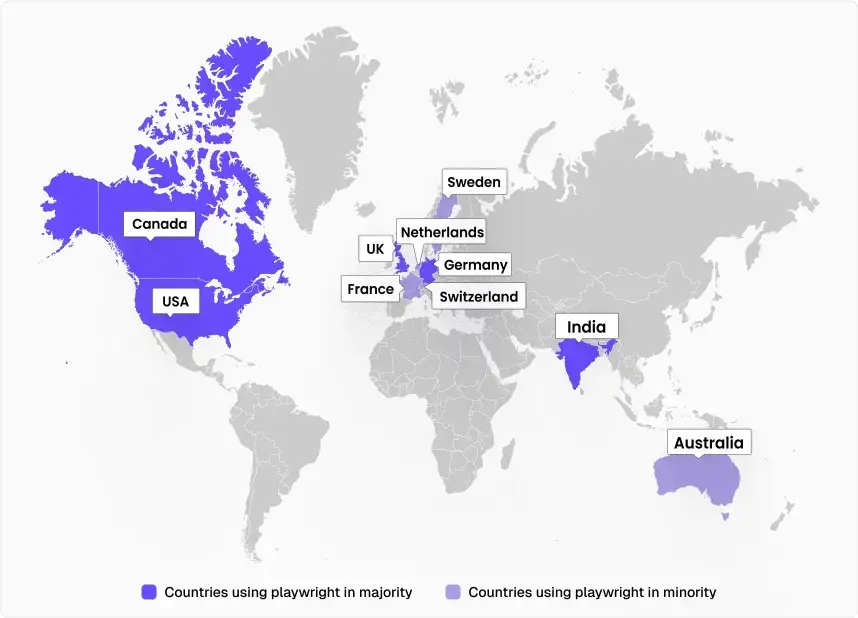
This spread signals maturing global Playwright adoption. India, in particular, has moved from third to a strong second position since 2025, reflecting the country's massive QA services industry migrating from Selenium to Playwright for new projects.
Playwright vs Selenium performance
1. Execution speed benchmarks
We reviewed the test runs published in the GitHub repo covering the full saucedemo flow in both Playwright and Cypress. We verified these results in our own setup using the same test scenarios. Anyone can reproduce these benchmarks by following the project's README.
Playwright vs Cypress speed comparison:
| Scenario | Playwright | Cypress | Playwright advantage |
|---|---|---|---|
| Headless mode | 14s | 24s | 42% faster |
| Headed mode | 15.5s | 21s | 26% faster |
| CI/CD pipeline | 42s | 100s | 2.4x faster |
| Average execution | 10.5s | 16s | 40% faster |
Playwright leverages headless browsers by default for faster execution and improved resource usage. Its built-in test runner enables running tests in parallel, which significantly reduces overall execution time for large suites.
These benchmarks matter most in CI environments. A 2.4x speed advantage in CI/CD pipelines translates directly to faster feedback loops, lower compute costs, and shorter deployment cycles. For a team running 500 tests across 10 parallel shards, the difference between 42 seconds and 100 seconds per shard adds up to hours saved per week.
For a team running 500 tests across 10 parallel shards, the difference between 42 seconds and 100 seconds per shard adds up to hours saved per week.
2. Reliability metrics
Testing framework reliability directly impacts maintenance overhead and team confidence:
- Auto-wait functionality: Playwright's built-in auto-waiting detects element readiness before interacting, dramatically reducing flaky tests compared to frameworks that require manual waits
- Network interception: Native request/response handling improves test stability by letting you mock APIs and control network conditions
- Parallel execution: Efficient resource utilization through worker-based parallelism speeds up test suites without sacrificing isolation
- Cross-browser support: A single API works across Chromium, Firefox, and WebKit. No driver management, no version mismatches
These reliability features explain why teams report significant reductions in flaky test rates after migrating to Playwright. The auto-wait mechanism alone eliminates the most common category of test flakiness: timing-related failures.
3. Technical capabilities
Framework feature comparison:
| Feature | Playwright | Cypress | Selenium |
|---|---|---|---|
| Cross-browser (Chromium, Firefox, WebKit) | Yes | Partial | Yes |
| Multi-language support | 4 (TS, Python, Java, .NET) | 1 (JS/TS) | 7+ |
| Built-in parallel execution | Yes | Paid (Cloud) | Via Grid |
| Auto-waiting | Native | Partial | Manual |
| API testing | Built-in | Plugin | Separate tool |
| Mobile emulation | Native | Limited | Via Appium |
| Network interception | Native | Native | Limited |
| Trace viewer | Built-in | Dashboard | Third-party |
| Component testing | Experimental | Built-in | No |
| Agentic/AI APIs | v1.59+ (screencast, bind) | No | No |
Source: Official documentation for each framework, May 2026
Playwright's v1.59 release added capabilities that no other framework currently offers: page.screencast for recording test execution with visual annotations, and browser.bind() for sharing browser sessions across AI agents and human developers. These features position Playwright as the first test framework built for AI-native workflows.
Adoption trends and market position
1. Industry survey data
The data referenced here draws from a survey that ran annually from 2018 to 2025, with approximately 200 responses each year. These results were cross-referenced with community interviews, conference polls, and TestGuild's annual aggregation.
Key findings:
| Framework | Adoption rate | Trend | Retention rate |
|---|---|---|---|
| Playwright | 45.1% | Growing | 94% |
| Selenium | 22.1% | Declining | 78% |
| Cypress | 14.4% | Stable | 82% |
| Other tools | 18.4% | Mixed | Varies |
Source: TestGuild Annual Survey, 2025
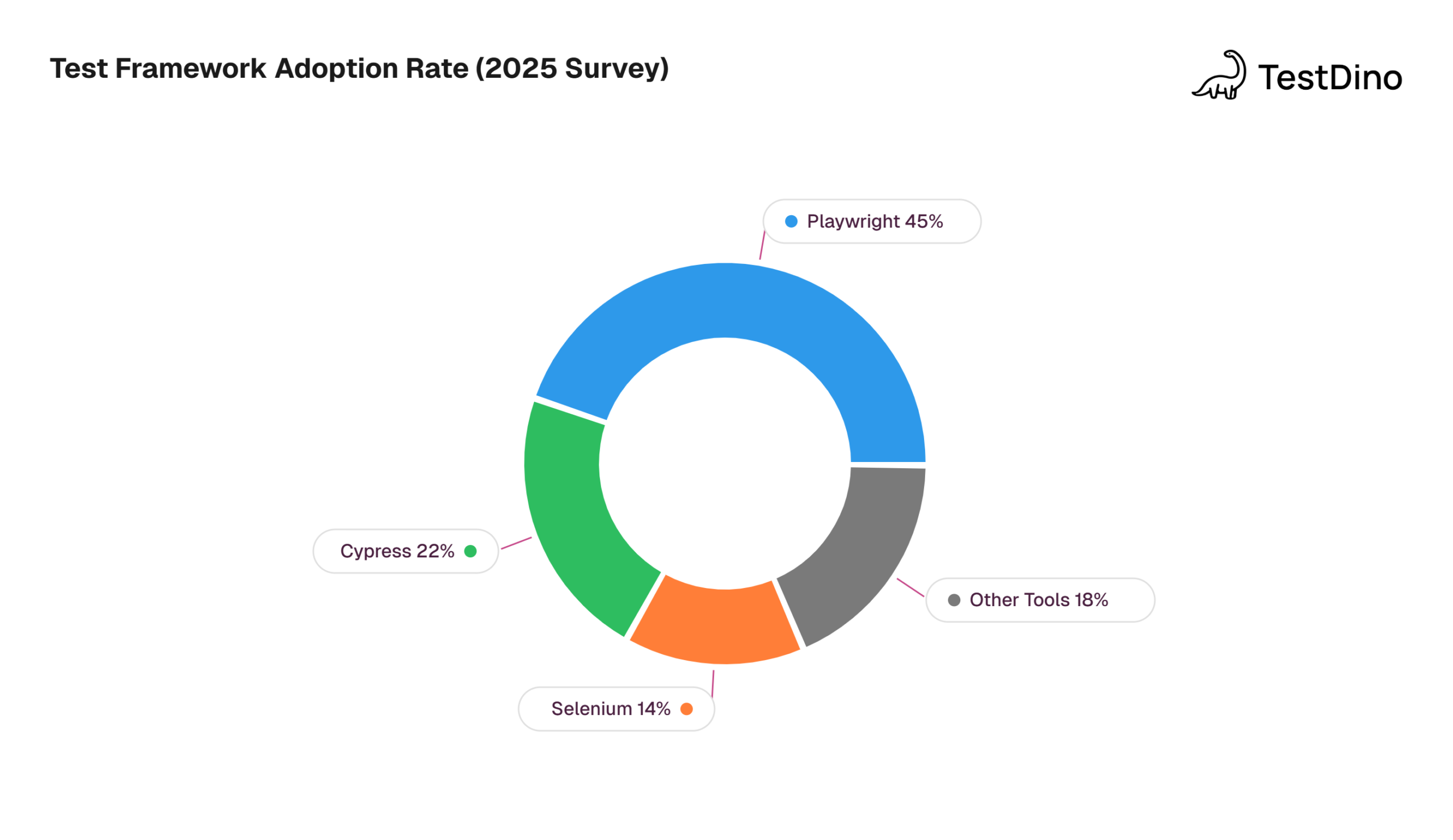
A 45.1% adoption rate with 94% retention tells a clear story: Playwright is not just attracting new users, it is keeping them. This combination of growth and retention is the strongest signal of product-market fit in the testing framework space.
2. Framework selection factors
Enterprises evaluate frameworks based on technical and business criteria. Understanding these factors helps explain the ongoing shift in Playwright vs Selenium market share.
Technical factors:
- Browser coverage requirements
- Programming language preferences
- CI/CD integration capabilities
- Test maintenance overhead
- Team skill sets and training needs
Business factors:
- Total cost of ownership
- Vendor support availability
- Community ecosystem strength
- Long-term roadmap certainty
- Migration complexity from existing tools
Market context
Gartner's Magic Quadrant for AI-Augmented Software Testing (October 2025) reports broader market trends:
- AI integration: 70% of enterprises will adopt AI-augmented testing by 2028, up from 20% in early 2025
- Automation growth: Testing automation investment is increasing across all sectors
- Skill shifts: Demand grows for modern framework expertise, with Playwright interview questions becoming standard in QA hiring
Playwright's early investment in AI-native features (MCP integration, Playwright CLI, screencast APIs) aligns directly with this Gartner prediction. Teams that adopt Playwright today are positioning themselves for the AI-augmented testing wave that Gartner expects to reach 70% enterprise penetration by 2028.
Market size and growth trajectory
Global market analysis
Precedence Research provides authoritative market sizing for the automation testing space:
Current market:
| Year | Market size (USD) |
|---|---|
| 2024 | $35.52 billion |
| 2025 | $41.67 billion |
| 2026 (projected) | $48.71 billion |
| 2034 (projected) | $169.33 billion |
CAGR: 16.90% (2025-2034)
Regional distribution:
- North America: 40% market share (2024)
- Asia Pacific: 20.03% CAGR (fastest-growing region)
- Europe: Steady growth in enterprise automation
Different research firms report varying figures. Research Nester projects USD 42.32 billion for 2026, while Fortune Business Insights estimates USD 24.25 billion. The gap reflects different market definitions: some include manual testing tools and services, others focus strictly on automation software.
Industry drivers
What is driving this 16.90% CAGR? The automation testing market is not growing in a vacuum. Several converging forces are pushing organizations to invest more in test automation:
Technology drivers:
- Cloud-native application proliferation
- Continuous deployment acceleration
- Microservices architecture adoption
- Mobile-first development strategies
- API-driven integration patterns
Business drivers:
- Digital transformation initiatives
- Competitive pressure for faster releases
- Quality assurance cost optimization
- Regulatory compliance requirements
- Customer experience focus
These factors drive growth in automation and increase Playwright demand as development teams adopt faster, AI-supported test workflows.
Technical architecture advantages
Browser automation protocol
How does Playwright talk to browsers? Playwright communicates directly with its bundled Chromium, WebKit, and Firefox engines through browser-specific protocols (CDP for Chromium, custom protocols for WebKit/Firefox). There is no middleman. It is like calling someone directly instead of going through a switchboard operator.
Selenium uses the WebDriver protocol, which adds a driver process (like chromedriver) between your test code and the browser. This extra hop introduces latency and is a common source of version-mismatch errors.
Cypress runs inside the browser itself with a Node.js process alongside it. This architecture gives it excellent debugging capabilities but limits it primarily to Chromium-based browsers.
This architectural difference is the root cause of Playwright's speed advantage in benchmarks. Fewer network hops mean faster command execution, which compounds across hundreds or thousands of test steps.
Developer experience
Playwright is designed to enhance developers' workflows, making it easier for development teams to integrate automated testing into their processes.
Productivity features:
- TypeScript-first: Strong typing and IDE support with full IntelliSense
- Codegen tool: Automatic test generation from browser interactions
- Trace viewer: Visual debugging with timeline inspection, DOM snapshots, and network logs
- Inspector: Step-through debugging capabilities with element picker
- Assertions: Built-in web-first assertions with auto-retry
- Fixtures: Composable setup/teardown for test isolation
- Page Object Model support: First-class patterns for maintainable test architecture
CI/CD integration
Native support for continuous integration environments makes Playwright a natural fit for modern DevOps pipelines:
- GitHub Actions (official actions available)
- GitLab CI (documented configurations)
- Jenkins (plugin ecosystem support)
- Azure DevOps (Microsoft integration)
- CircleCI (community configurations)
TestDino's CI optimization features complement Playwright's CI support by enabling teams to rerun only failed tests, cache browser binaries, and get AI-powered failure analysis directly in their pipeline.
Comparative analysis summary
Playwright strengths
Based on verified metrics and official documentation:
Technical advantages:
- Modern architecture designed for current web standards
- Cross-browser support including WebKit/Safari testing
- Native mobile device emulation without external services
- Built-in API testing capabilities
- Auto-waiting reduces test flakiness
- Visual testing with screenshot comparison
- Screencast recording for agentic video receipts (v1.59+)
Ecosystem benefits:
- Active Microsoft-backed development
- Growing community contribution rate (720+ contributors)
- Comprehensive official documentation
- Consistent release cadence (monthly minor releases)
- Strong TypeScript integration
- AI ecosystem support with MCP, CLI, and Skills
Framework selection guidance
Choose Playwright when:
- Cross-browser testing including Safari is required
- Team prefers TypeScript or modern JavaScript
- Mobile web testing needed without external services
- API and E2E testing should use a single framework
- Fast CI execution speed is a priority
Choose Selenium when:
- Existing Java-based testing infrastructure exists
- Legacy browser versions must be supported
- Team expertise centers on Java/Python
- Extensive third-party tool integration required
- Multi-language support (7+ languages) is a hard requirement
Choose Cypress when:
- Focusing solely on Chromium-based browsers is acceptable
- Real-time debugging during development is valued
- Time-travel debugging feature needed
- Component testing is the primary use case
- Simpler learning curve for JavaScript beginners is prioritized
Migration considerations
What does migration complexity look like in practice? Moving from Selenium to Playwright typically involves rewriting test files (selectors, waits, assertions) but keeping your test logic and page objects largely intact. The Playwright migration guide provides step-by-step instructions.
| Migration path | Complexity | Typical timeline |
|---|---|---|
| Selenium to Playwright | Medium | 2-4 weeks per 100 tests |
| Cypress to Playwright | Low-Medium | 1-3 weeks per 100 tests |
| Protractor to Playwright | Low | 1-2 weeks per 100 tests |
| New project (greenfield) | None | Immediate |
Teams considering migration should review the Playwright automation checklist to reduce flaky tests from day one.
Future outlook and recommendations
Market trajectory
- Growth indicators point to continued Playwright dominance through 2026 and beyond:
- Increasing Fortune 500 adoption validates enterprise readiness
- GitHub activity demonstrates strong community momentum (88,500+ stars, 720+ contributors)
- npm download growth rate outpaces all competitors
- Geographic expansion shows global acceptance
- Framework maturity reduces migration risk
Technology roadmap
The official Playwright release notes show active development with features landing monthly:
Recent additions (v1.57-v1.59):
- Screencast API for recording test execution with visual annotations
- browser.bind() for shared browser sessions across AI agents
- Playwright CLI dashboard for monitoring agent browser sessions
- Enhanced ARIA snapshots for accessibility testing
- Trace CLI for shell-based trace analysis
- await using support for cleaner resource cleanup
- --debug=cli mode for headless debugging
Upcoming (v1.60 canary):
- HAR recording as a first-class tracing API
- locator.drop() for drag-and-drop file testing
- test.abort() for failing tests from fixtures
- Page-level ARIA snapshot assertions
These updates position Playwright as the first test framework built for AI-native development workflows, where coding agents and human developers share browser sessions and exchange visual evidence of test results.
Strategic recommendations
For new projects:
- Evaluate Playwright as the primary option for modern web applications
- Consider team JavaScript/TypeScript proficiency
- Assess cross-browser testing requirements
- Review CI/CD integration needs
- Plan for team training investment using the Playwright cheatsheet
For existing projects:
- Audit current framework pain points and costs
- Pilot Playwright on non-critical test suites
- Compare execution speed and maintenance overhead using reporting metrics
- Evaluate migration effort versus benefit
- Plan phased adoption if migration is justified
Conclusion
Playwright's market position in 2026 is backed by hard numbers. It holds 88,500+ GitHub stars, powers 500,000+ repositories, pulls 52 million weekly npm downloads, and runs inside 12,000+ verified companies. The gap between Playwright and its nearest competitors continues to widen on every measurable axis.
The automation testing market is projected to grow from $41.67 billion in 2025 to $169.33 billion by 2034. Playwright sits at the center of this expansion with a 45.1% adoption rate, 94% retention, and the only framework actively shipping AI-native features like screencast recording and shared browser sessions.
If you are planning your test infrastructure for 2026 and beyond, these numbers provide a solid foundation for your framework decision. The data points to a clear trajectory: Playwright is not just growing, it is pulling away.
FAQs
2026, it commands a 45.1% adoption rate among QA professionals with an exceptional 94% retention rate. It leads all competitors in raw usage, pulling 52 million weekly npm
downloads, and is actively used by over 12,000 verified enterprise companies, cementing its position as the industry standard for modern web testing.
As of May 2026, the microsoft/playwright repository boasts over 88,500 stars, significantly outpacing Cypress (49,600) and Selenium (34,100).
Furthermore, Playwright maintains a highly active community with over 720 contributors and is depended upon by more than 500,000 public GitHub repositories.
release cadence, typically publishing a new minor version every month (such as v1.59 in April 2026). It offers native multi-language support, allowing engineering teams to
write tests in TypeScript, JavaScript, Python, Java, and .NET (C#) without requiring third-party bindings.
sectors, followed closely by Finance, IT Services, and Manufacturing. Geographically, the United States is the leading market for enterprise adoption, driven by tech
modernization initiatives. Meanwhile, India represents the fastest-growing region, as its massive QA services sector increasingly migrates from legacy tools to Playwright
for new projects.
design. Unlike Selenium, which relies on the WebDriver intermediary, Playwright communicates directly with browser engines (Chromium, Firefox, WebKit), resulting in
execution times up to 2.4x faster in CI/CD pipelines. Additionally, built-in features like auto-waiting drastically reduce flaky tests, while newer agentic capabilities
(page.screencast, browser.bind()) make it the premier choice for AI-augmented testing
workflows.
Table of content
Flaky tests killing your velocity?
TestDino auto-detects flakiness, categorizes root causes, tracks patterns over time.
Follow Us